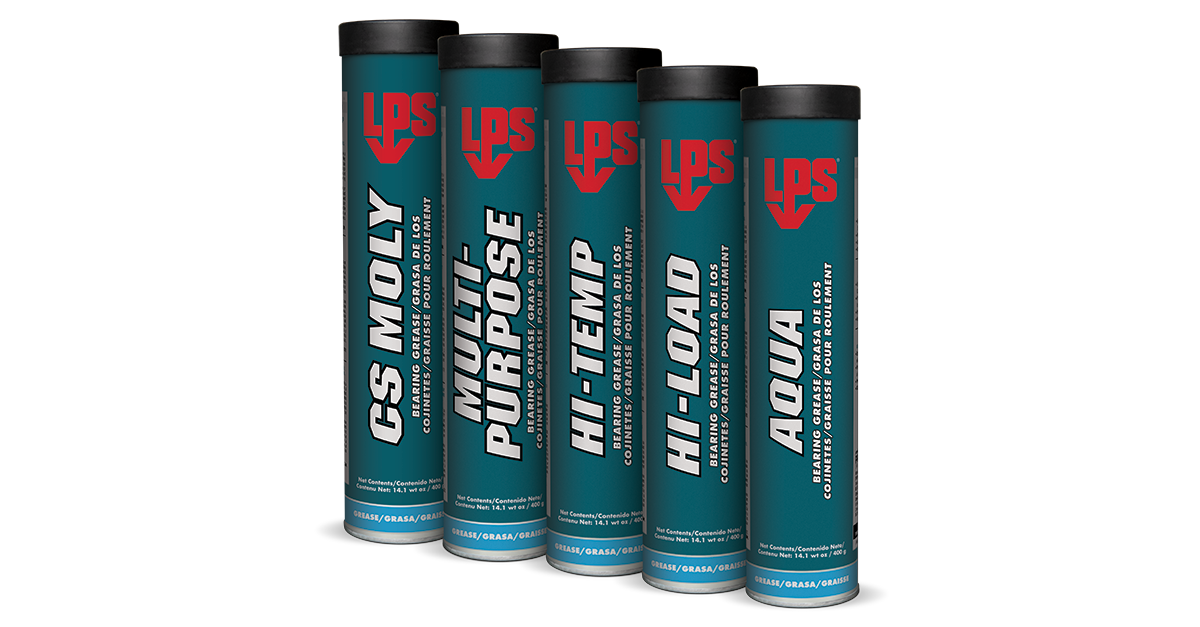
National Lubricating Grease Institute or NLGI describes the various grease grades primarily based on viscosity and, specifically, working penetration testing. This testing involves a rather elaborate machine that tests the reaction of grease penetration of a known weighted cone shaped device (it's sort of like your pocket and a politician - the deeper your pocket, the deeper the politician digs).
Grease grades 000 through 1 are rather liquid in appearance and lower in viscosity. As the grades increase in number, so does the viscosity of the grease until it reaches the number 6 which is a solid. The most utilized industrial grade is "NLGI #2" which is exactly what LPS® greases are. Greases above 2 are more viscous and those below 2 are less. Check out the chart below*. It gives a quick rundown of the various grease NLGI grades, working penetration results, appearance, and a food analogy. If you wish to know more about greases generally, Google and Wikipedia are great starts. If you have specific grease questions, give one of ITW Pro Brands' knowledgeable Applications Engineers or Regional Sales Reps a call.
| NLGI Grade | Worked penetration after 60 Strokes at 25° C (0.1mm) | Appearance | Consistency Food Analogy |
| 000 | 445-475 | fluid | cooking oil |
| 00 | 400-430 | semi-fluid | applesauce |
| 0 | 355-385 | soft | brown mustard |
| 1 | 310-340 | very soft | tomato paste |
| 2 | 265-296 | "normal" grease | peanut butter (yum!) |
| 3 | 220-250 | firm | vegetable shortening |
| 4 | 174-205 | very firm | frozen yogurt (tasty!) |
| 5 | 130-160 | hard | smooth pate |
| 6 | 85-115 | very hard | cheddar cheese |
By the way, the top-selling product in the ITW Pro Brands line is LPS Multi-Purpose Bearing Grease. It is a smooth, blue, lithium complex grease compatible with all metals that will provide both long term lubrication and corrosion protection to your critical bearings, slides, etc. Need something with a broader temperature range and more "oomph"? Check out CS Moly Bearing Grease. It is the fix for those heavy-duty load and stress applications.
*Reference: Wikipedia