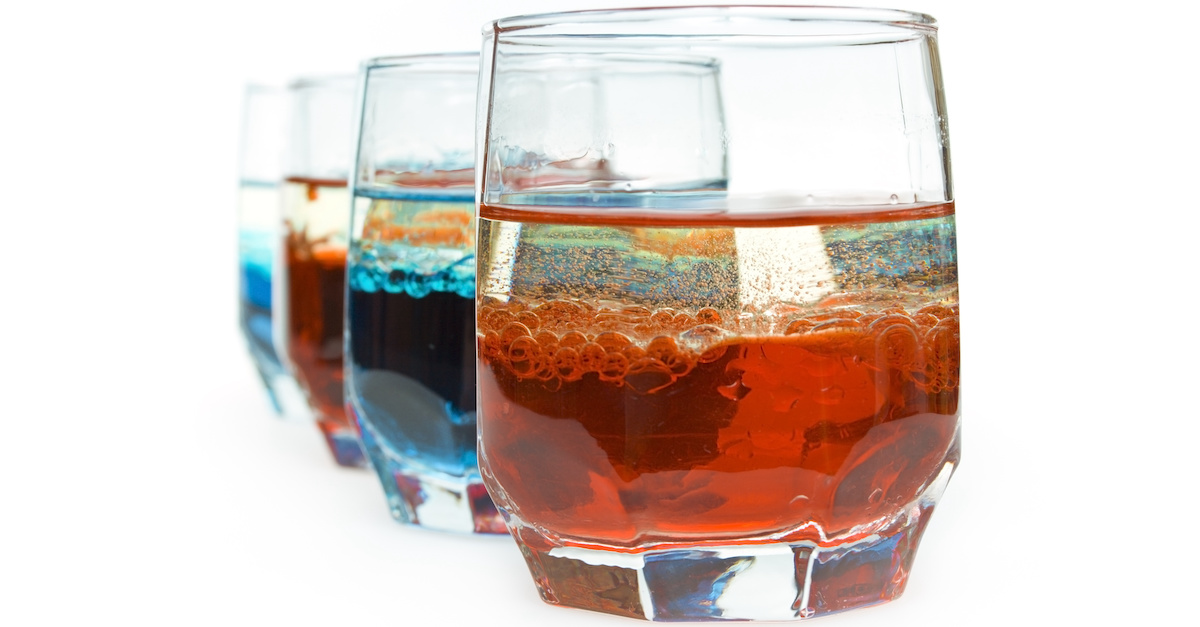
I like milk. It’s a healthy drink loaded with the essential stuff that keeps me “young, suave, and debonair”. Did you know that milk is actually a naturally occurring emulsion*? True. It’s actually water and natural oils (fats) held together with an “emulsifier” commonly referred by nerds as a surfactant or coupling agent (more about this critter later on). Milk is around 85-87% water with other stuff in there including fat (oils). In fact, milk can be defined as an “oil-in-water” emulsion. It’s a water matrix (mostly H2O) with tiny globules of fat evenly intersperse though out the water giving the opaque or milky look of…well, milk. The oil and water in milk is held together by a natural fairy dust called a surfactant. A surfactant allows the even distribution of either oil in water or water in oil depending on which is the more prevalent ingredient. If our friend the surfactant wasn’t used the oil would form a distinct layer on top of the water. The surfactant binds the two normally apposed liquids together into one happy medium. Now, if you have ever let milk set for days and days and days (like you did in the fridge in college) you probably noted two things: one, the milk has disintegrated into two layers and two, it reeks. What happened here is the surfactant broke down over time then the milk went south to biodegrade.
So how does a surfactant or surface active agent work? Well my budding wannabe nerds, here is a little behind the scenes magic. In a dark cellar, an R&D Master Wizard (Level 10) extraordinaire dons his pointy hat then, waves his test tube over the smoldering kettle, adds a bit of eye of newt, then mutters a few powerful technical intonations and POOF! an emulsion forms.
What?!? You don’t buy it? OK, here is the way it really works:
A surfactant ingredient, commonly known as the coupling or emulsifying agent in chemical parlay, is added to the water. Next the oil is added slowly allowing the coupling agent (emulsifying surfactant) to bind with both the water and the oil. What is neat about the coupling agent/surfactant is this: it is a double key. What I mean is the coupling agent/surfactant molecule has two different keys attached to it. One key fits the lock on the oil molecule then the other key fits the lock on the water molecule. The end result is an emulsion that is either oil-in-water or water-in-oil. Break one or the other key by freezing, overheating, etc., the emulsion fails i.e. layers out. Neat, huh? Personally, I like the Master Wizard version better, but I suppose we should stick with reality. Bummer…
I bet many of you did not realize that we at ITW Pro Brands plays around with emulsions all the time. In fact there are products in several of our brands that are, or can form, emulsions. These include our Rustlick™ metalworking fluids and LPS® Heavy-Duty Silicone Lubricant, etc.
What good is an emulsion you ask? Well for one it unites both the water-based world and the world of solvents (oils) together to fight dirt, grime, and friction. You know, kind of like Batman and Superman rolled into one super duper superhero. Secondly, it also allows shipment of concentrates (like Metalworking Fluids) without all the extra water weight. Simply mix the metal working product to water for economics when you recharge the sump.
EXTRA! EXTRA! EXTRA!
*For you overachievers in the crowd, here is a bit more techno info on emulsions courtesy of Wikipedia:
An emulsion is a mixture of two or more liquids that are normally immiscible (unmixable or unblendable). Emulsions are part of a more general class of two-phase systems of matter called colloids. Although the terms colloid and emulsion are sometimes used interchangeably, emulsion should be used when both the dispersed and the continuous phase are liquids. In an emulsion, one liquid (the dispersed phase) is dispersed in the other (the continuous phase). Examples of emulsions include vinaigrettes, milk, mayonnaise, and some cutting fluids for metalworking.
The word "emulsion" comes from the Latin word for "to milk", as milk is an emulsion of fat and water, among other components.
Two liquids can form different types of emulsions. As an example, oil and water can form, first, an oil-in-water emulsion, wherein the oil is the dispersed phase, and water is the dispersion medium. Second, they can form a water-in-oil emulsion, wherein water is the dispersed phase and oil is the external phase. Multiple emulsions are also possible, including a "water-in-oil-in-water" emulsion and an "oil-in-water-in-oil" emulsion.[3] Whoa dude slow your roll…you are getting a bit carried away now.
Emulsions, being liquids, do not exhibit a static internal structure. The droplets dispersed in the liquid matrix (called the “dispersion medium”) are usually assumed to be statistically distributed. Dang it. They had to bring math into this… Well, that’s enough techno stuff on for this blog.
Reward yourself: Go have a nice tall glass of milk and maybe a cookie (or three).